


OUR PROPOSAL FOR SEMIPAN 2026
Even a lay observer — including unbelievers outside the Church — when reading the constant news about internal scandals or analyzing global evangelization statistics, can clearly perceive that institutional Christianity is facing a serious crisis. The data reveal a significant failure in reaching peoples and territories, a scenario in which the Church has been shamefully surpassed by ideological systems openly opposed to Christianity, such as Islam, which emerged centuries later and yet continues to expand rapidly.
In direct contradiction to Jesus’ request to the Father in His priestly prayer — that His followers might be one (John 17) — the Church has fragmented into countless denominations. Many of these, after growing, further subdivided, giving rise to structures governed by their own statutes, regulations, and, in many cases, doctrines that drift away from Scripture, often driven by financial interests, personal benefits, and institutional power.
To make matters worse, so-called “inclusive churches” have emerged, relativizing or rejecting fundamental biblical principles by embracing practices that Scripture clearly condemns. In these environments, conversion, repentance, the new birth, and holiness have been diluted or replaced by messages of acceptance without transformation — in clear opposition to biblical teaching:
“Pursue peace with all people, and holiness, without which no one will see the Lord.”
(Hebrews 12:14)
The consequence of this doctrinal relaxation and rejection of sound teaching has been the formation of a generation of Christians driven primarily by the pursuit of material blessings, comfort, and wealth. Prosperity theology has dominated many pulpits, promoting a transactional view of faith in which offerings are presented as a means to financial gain. This system has produced millionaire pastors while missionaries serving in hostile, persecuted, and impoverished regions remain abandoned, without financial, emotional, or logistical support.
Over the past four decades, this imbalance has transformed today’s Church into a paradoxical reality: millionaire pastors and impoverished missionaries. The impact is evident in global evangelization statistics. The Church can gather massive crowds in large-scale events and spectacular productions, yet remains weak and ineffective in fulfilling its primary mission — reaching the unreached and sustaining those on the front lines.
While well-funded churches spend excessively on non-essential expenses, missionaries in the field struggle with basic needs. Denominational meetings begin and end without any concrete missionary strategy focused on unreached peoples. Instead, political agendas, internal power struggles, and electoral mobilizations dominate the conversation. Missionary appeals, even when supported by clear facts and data, are often ignored under the excuse of lack of time or priority.
This is the critical landscape that any attentive observer can confirm. The situation becomes even more alarming for those who understand what occurs behind the scenes of today’s religious system.
However, the mechanism of global evangelization described in Romans 10:13–15 was entrusted by God to human beings. Therefore, it is the responsibility of human beings to identify failures, correct deviations, and restore proper function. Every restoration process begins with knowledge, diagnosis, and an honest confrontation with reality, followed by decisive action.
This is precisely the purpose of SEMIPAN 2026.
Ministers of the Gospel, leaders, and those responsible for missionary work who gather in Charlotte, North Carolina, from September 18–20, 2026, will dedicate themselves to a serious evaluation of the global missionary landscape, the correction of concepts, the realignment of priorities, and the construction of practical strategies to fulfill the Great Commission in its entirety.
Therefore, prepare your delegation and come.
OUR LAST CHANCE
At SEMIPAN – Pan-American Missiological Seminary, we work from two essential foundations to equip Christians to fulfill the mission entrusted to them by Christ: to preach the Gospel, transform lives, and win souls.
1. Biblical Foundation
At SEMIPAN, we carry out a careful and responsible examination of the Scriptures, considering:
- The direct teachings of Jesus Christ and His own example of full dedication to evangelizing people.
- The practices of the apostles in the Early Church, as recorded in the historical book of Acts.
- The apostolic teachings, with particular emphasis on the letters of the Apostle Paul, which form the theological backbone of Christian mission
This biblical foundation is indispensable for correcting course, restoring priorities, and aligning the contemporary Church with the command of the Great Commission.
2. Updated Statistical Foundations
In addition to biblical grounding, SEMIPAN works with reliable and up-to-date statistical data on global evangelization. These figures allow us to evaluate, with clarity and responsibility, how the Church has performed its mission over recent decades.
These data also enable comparisons between the growth of Christianity and the expansion of other religious movements — including those that stand in direct opposition to Christianity, such as radical Islam, which in many regions persecutes, expels, and even executes Christians.
For this reason, it is essential that every Christian takes time to understand the facts, so they can make an informed and responsible decision about their role in the challenges facing the Church today.
World Population by Religion – Recent Data
According to widely accepted estimates from recognized institutions such as:
- Pew Research Center
- World Religion Database (ARDA)
- Oxford Centre for Religion and Public Life
the approximate global religious distribution for 2025–2026 is:

Current conclusion:
Based on reliable demographic research, Christianity remains the largest religion in the world by number of adherents
Projected Growth
Although Christianity remains numerically larger, demographic studies reveal concerning trends:
- Islam is the fastest-growing religion in percentage terms.
- Factors such as higher birth rates in predominantly Muslim regions and continuous territorial expansion contribute to this growth.
- Projections indicate that, if current trends continue, Islam may approach or surpass Christianity in total number of adherents in the coming decades, possibly around 2050 or later.
These projections are not speculative but are based on long-term demographic patterns observed prior to and after 2020.
Correct Interpretation of the Data
It is crucial to interpret the data accurately:
-
Christianity is still numerically larger:
-
- Christianity: approximately 2.4–2.5 billion people (31%)
- Islam: approximately 1.9–2.2 billion people (24–26%)
-
- Islam is growing at a faster rate, which constitutes a strategic and missiological warning.
Faster growth does not mean Islam has already surpassed Christianity, but it clearly signals that the time to respond is now.
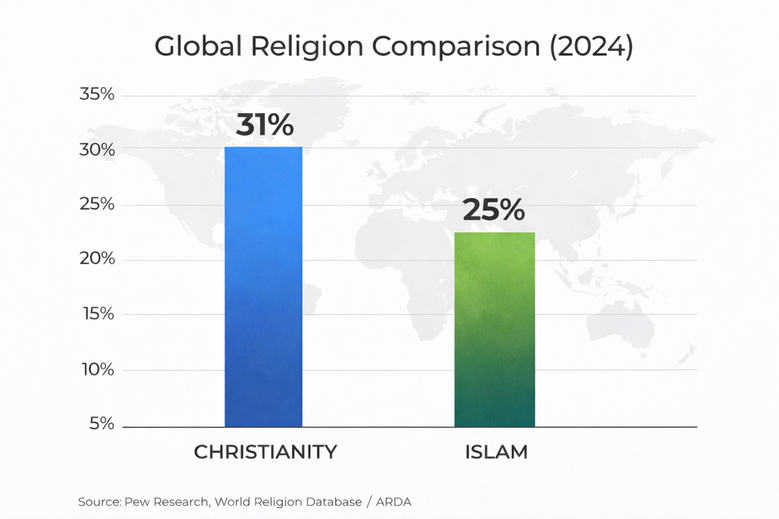
Overall result:
Christianity still leads numerically, but Islam is advancing at a significantly faster pace.
What May Happen in the Future
According to demographic projections:
- If current trends persist, Islam may equal or slightly surpass Christianity in total numbers in future decades.
- This has not yet happened, but it remains a realistic possibility if no corrective action is taken.
It is also important to note that Islam historically maintains an explicit expansionist vision, making the missiological challenge even more urgent.
The Necessary Response
In light of this reality, it becomes urgent and unavoidable that:
- Church leaders,
- Ministries,
- Denominations and Christian organizations
gather to take decisive action, strengthening global missions and restoring the biblical vision of missionary sending.
SEMIPAN 2026 exists for this very purpose:
to diagnose the situation, correct course, and mobilize the Church before it becomes too late to respond.